



Industrial IoT vs Consumer IoT
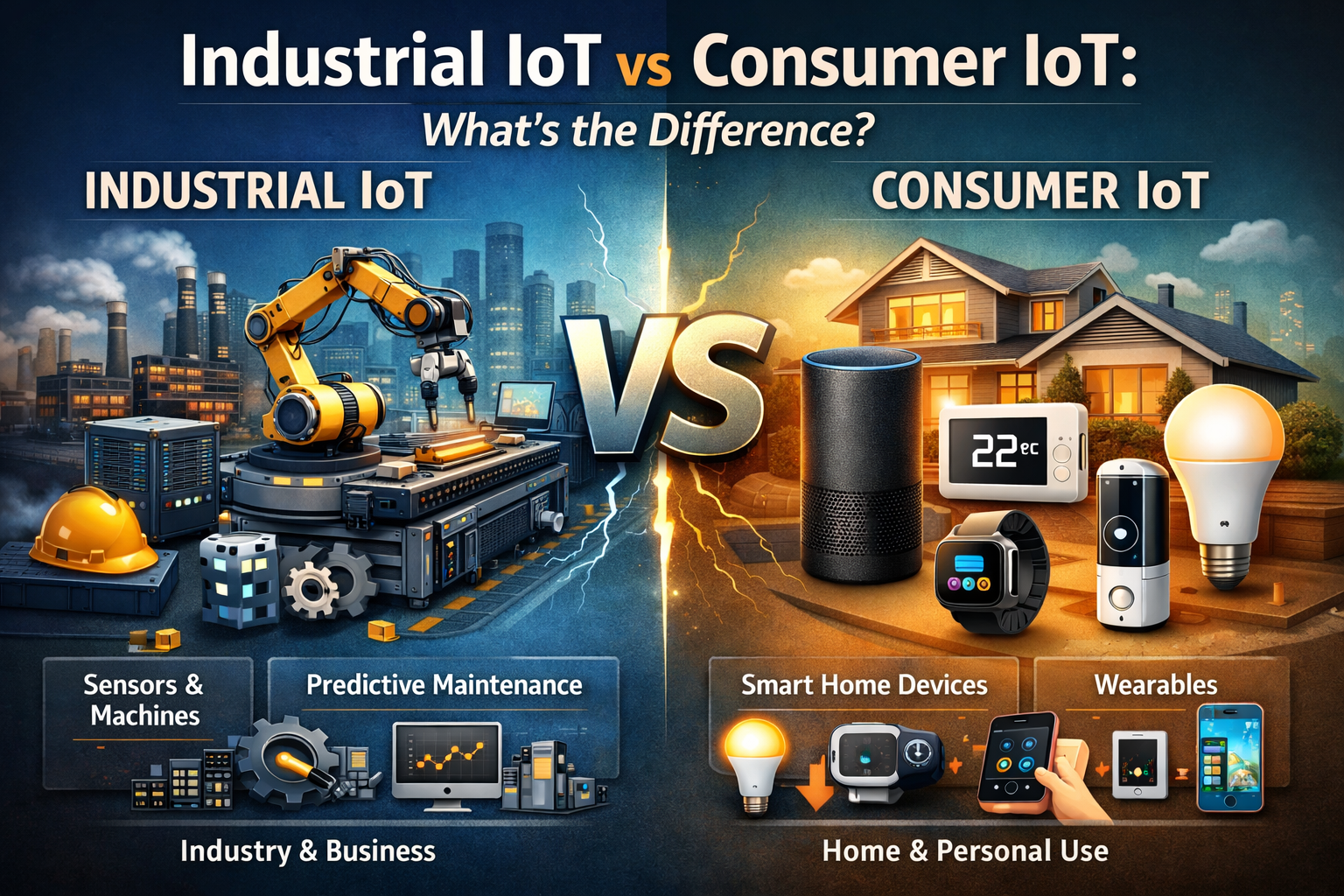
The Internet of Things (IoT) has transformed the way devices connect, communicate, and share data. From smart homes to advanced factory systems, IoT technology is enabling automation, improving efficiency, and helping organizations make better data-driven decisions.
However, IoT is not a single category. It generally falls into two major segments:
- Industrial IoT (IIoT)
- Consumer IoT (CIoT)
While both involve connected devices and data sharing, they differ significantly in purpose, scale, reliability, and complexity.
Understanding these differences is essential for businesses evaluating IoT technologies and for individuals looking to adopt smart devices in everyday life.
What is Industrial IoT (IIoT)?
Industrial IoT (IIoT) refers to the use of connected sensors, machines, and data systems within industrial environments such as manufacturing plants, logistics operations, utilities, and large-scale infrastructure.
The primary goal of IIoT is to improve operational efficiency, reduce downtime, enhance safety, and optimize productivity.
In industrial settings, IoT devices are typically deployed to monitor machinery, track assets, collect environmental data, and automate operational processes.
For example, factories may install vibration sensors on machinery to detect potential failures before they occur. This allows companies to perform predictive maintenance, preventing costly breakdowns and production delays.
Similarly, logistics companies often use IoT sensors to track shipments, monitor temperature conditions, and optimize delivery routes.
Common Industrial IoT Applications
Industrial IoT technologies are used across a wide range of industries, including:
Manufacturing
- Equipment monitoring
- Predictive maintenance
- Automated production lines
- Quality control systems
Energy and Utilities
- Smart energy grids
- Power infrastructure monitoring
- Pipeline leak detection
- Remote facility monitoring
Logistics and Supply Chain
- Fleet tracking
- Asset tracking
- Cold-chain monitoring
- Warehouse automation
Agriculture
- Soil monitoring
- Smart irrigation
- Livestock tracking
- Crop health analysis
Industrial IoT systems often involve hundreds or thousands of sensors connected to centralized platforms, generating large volumes of operational data that can be analyzed in real time.
What is Consumer IoT?
Consumer IoT refers to connected devices designed for personal use in homes and everyday environments. These devices aim to improve convenience, comfort, security, and entertainment.
Most consumer IoT products are designed to be easy to install, affordable, and user-friendly.
Examples of consumer IoT devices include:
- Smart thermostats
- Smart speakers
- Smart lighting systems
- Home security cameras
- Wearable fitness trackers
- Smart doorbells
Many consumer IoT devices can be controlled through mobile apps or voice assistants, allowing users to manage their home environment remotely.
For example, a smart thermostat can automatically adjust home temperatures based on daily routines, while a smart lighting system can turn lights on or off based on motion detection.
Consumer IoT devices are typically integrated into smart home ecosystems, where multiple devices work together to automate everyday tasks.
Key Differences Between Industrial IoT and Consumer IoT
Although both Industrial IoT and Consumer IoT rely on connected devices and data networks, they serve very different purposes.
Below are the key differences between the two categories.
- Purpose and Objectives
The most significant difference lies in why the technology is used.
Industrial IoT focuses on improving operational efficiency and productivity in business environments. Its primary objective is to increase performance, reduce costs, and enhance safety.
Consumer IoT, on the other hand, is designed to improve convenience and lifestyle experiences for individuals.
For example:
- An industrial IoT sensor might monitor the health of a turbine in a power plant.
- A consumer IoT device might automatically turn on your home lights when you enter a room.
Both use connected devices, but the value and scale of impact are very different.
- Scale of Deployment
Industrial IoT deployments are usually much larger and more complex.
Large factories may use thousands of sensors to monitor machinery, production lines, temperature, vibration, and energy consumption.
These systems often integrate with enterprise software such as:
- Manufacturing execution systems (MES)
- Enterprise resource planning (ERP) platforms
- Data analytics platforms
Consumer IoT deployments are typically smaller and simpler, usually involving a few devices in a home.
A typical smart home might include:
- Smart lights
- A smart thermostat
- Security cameras
- A smart speaker
Compared to industrial systems, the scale is significantly smaller.
- Reliability Requirements
Industrial IoT systems must meet extremely high reliability standards.
If a connected sensor fails in an industrial environment, it can lead to:
- Equipment damage
- Production downtime
- Safety hazards
- Financial losses
As a result, industrial IoT devices are built to withstand harsh environments, including:
- Extreme temperatures
- Vibration
- Dust and moisture
- Heavy mechanical stress
Consumer IoT devices do not face these same conditions and are typically designed for indoor residential environments.
- Security and Data Protection
Security is a critical concern for both types of IoT, but the stakes are much higher in industrial environments.
Industrial systems may control critical infrastructure such as:
- Power grids
- Manufacturing systems
- Transportation networks
A cyberattack targeting industrial IoT systems could potentially disrupt entire operations or compromise safety.
For this reason, industrial IoT deployments often involve advanced cybersecurity frameworks, encryption protocols, and strict access controls.
Consumer IoT security is also important, but the primary risks are typically related to:
- Privacy concerns
- Data protection
- Unauthorized device access
- Cost and Investment
Industrial IoT solutions typically involve significant upfront investment.
Businesses must consider costs related to:
- Sensors and hardware
- Network infrastructure
- Data analytics platforms
- System integration
- Ongoing maintenance
However, these investments often produce substantial long-term returns by improving operational efficiency and reducing maintenance costs.
Consumer IoT devices are generally designed to be affordable and accessible, with many smart home devices costing less than a few hundred dollars.
- Connectivity Technologies
Industrial IoT systems often use specialized communication technologies designed for long-range connectivity and low power consumption.
Common industrial IoT connectivity options include:
- LPWAN networks
- LoRaWAN
- Cellular IoT
- Private industrial networks
These technologies allow devices to transmit data over long distances while maintaining battery efficiency.
Consumer IoT devices typically rely on standard household connectivity options, such as:
- Wi-Fi
- Bluetooth
- Zigbee
- Thread
These technologies are well suited for short-range home networks.
- Data Processing and Analytics
Industrial IoT generates massive amounts of operational data, which must be processed and analyzed to generate useful insights.
Many IIoT systems incorporate:
- Edge computing
- Machine learning
- Predictive analytics
These technologies allow organizations to detect issues, predict equipment failures, and optimize processes in real time.
Consumer IoT data is typically used for automation and personalization, such as learning user habits or optimizing home energy usage.
The complexity of industrial data analysis is significantly higher.
Where the Two Worlds Overlap
Despite their differences, Industrial IoT and Consumer IoT share several underlying technologies.
Both rely on:
- Connected sensors
- Cloud platforms
- Data analytics
- Automation systems
In recent years, we have also seen the rise of commercial IoT, which sits between the two categories.
Examples include:
- Smart buildings
- Connected retail stores
- Intelligent office spaces
These environments combine industrial monitoring systems with consumer-style automation features.
The Future of IoT
As IoT technology continues to evolve, the line between industrial and consumer systems may become less distinct.
Advancements in areas such as:
- Artificial intelligence
- 5G connectivity
- Edge computing
- Digital twins
are making IoT systems more powerful and scalable.
Industrial IoT is expected to play a major role in the development of Industry 4.0, where factories become highly automated and data-driven.
Meanwhile, consumer IoT will continue expanding as smart homes become more common and connected devices become more affordable.
Both segments are expected to grow rapidly as businesses and individuals increasingly rely on connected technology to improve efficiency and quality of life.
Final Thoughts
Industrial IoT and Consumer IoT both represent powerful applications of connected technology, but they serve very different purposes.
Industrial IoT focuses on optimizing business operations, improving productivity, and enhancing safety in complex industrial environments.
Consumer IoT, in contrast, is designed to make everyday life more convenient through smart home devices and connected consumer products.
Understanding the differences between these two segments is important for organizations exploring IoT deployments and for individuals adopting smart technology.
As IoT continues to evolve, both industrial and consumer applications will play a critical role in shaping the future of connected technology.